|
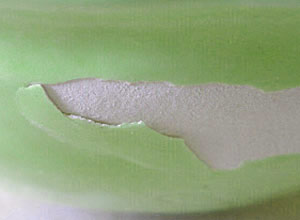
Shivering is a severe glaze problem that occurs when a glaze is under too much compression. The fired glaze looks like a paint chip peeling off the underlying clay body. Shivering can tear or break the underlying clay body, causing the whole pot to crack apart upon cooling.
Shivering can develop as the piece cools or sometimes years later! Essentially when the glaze is under extreme compression, it might "buckle'' at any given time.
Shivering and crazing are at opposite ends of the same basic problem: The glaze and clay body do not fit when cool. Crazing happens when the glaze is under extreme tension. Interestingly, ceramic materials fail ten times faster under tension than compression. Correspondingly, crazing (glaze under tension) is ten times more prevalent as a glaze defect as compared to shivering. Recognizing and understanding a problem are the first steps in solving any glaze defect.
Shivering can occur at any temperature range, in oxidation or reduction. Frequently, when a glaze does shiver or peel off the fired clay surface, it is on the pot's edges or raised areas. The chip size can range from 1/16 inch to more than 2 inches in size. With any correction, the goal should be to have the clay and glaze cool at a compatible rate, with the glaze coming under slight compression as it cools.
Although shivering is classified as a glaze defect, it can be corrected through adjustments to the glaze recipe, the clay body recipe or a combination of the two. Several points must be considered before attempting to fix a glaze shivering defect: Clay bodies containing too much free silica can cause shivering; fireclays, as a group, are known to have randomly high levels of free silica. Fine grog high in silica can also cause shivering, especially if burnishing has brought it to the clay surface in the forming process.
The following five steps are recommended to correct shivering. The first involves adding high-expansion materials (feldspars or other alkali-bearing materials) to the clay body and/or glaze. Decreasing low-expansion materials (flint) from the clay body and/or glaze also must sole the problem. Sometimes a combination of both methods will be necessary.
1. If only one glaze is shivering on the clay body, try additions of 5, 10 or 15 parts potash feldspar to that glaze.
2. Decreasing the flint in a glaze by 5 or 10 parts will also adjust the clay body/glaze fit.
3.Occasionally, adding feldspar/frit and removing flint will be necessary to stop shivering.
4.If many different types of glazes are shivering on the same body; correct the problem by adding 5, 10 and 15 parts feldspar (or other alkali-bearing materials) to the clay recipe.
5. A decrease of 5 or 10 parts flint in the clay body may also correct glaze shivering.
In most instances, shivering can be corrected by additions of feldspar, frit or other high-expansion materials to the glaze. If the problem persists, the solution is to adjust the clay body recipe or change to another clay body altogether.
|