|
Alumina
|
A major component of the chemical composition of clays, clay bodies and most glazes.
|
|
Absorbency
|
The ability of porous materials to attract a liquid (water) into its air spaces. In the production of pottery this is useful for the application of glaze to bisque ware in preparation for the glaze firing. The absorption rate of finished pieces (after firing) should be of concern to the consumer. Pieces with lower absorption rates tend to be more durable. See also bisque.
|
| Ball Clay |
A secondary clay moved from the parent rock, ball clay is often mixed with other clays and minerals, organic matter are frequently present. Ball clays commonly exhibit high plasticity and high dry strength
|
| Bat |
Thin slab of wood, plaster, or plastic used to support pottery forms during throwing, attached to the head of the potter's wheel by clay body or "bat pins"
|
| Bat Pins |
Bat pins are to affix your bat to the pottery wheel when throwing on a pottery wheel. |
| Bentonite |
An extremely plastic clay which can be added in small quantities to short clay to make it more plastic.
|
|
Bisque
|
This term may also be seen as bisc, biscuit, bisqueware, bisquefired, biscuit. Refers to both a preparation firing process and the pottery piece that has undergone the firing. The firing is to a temperature that brings about a physical and chemical change to clay. Atomically attached molecules of water are driven off the individual clay particles and they are fused together transforming them into one piece. This intermediate step in glazed ceramics gives bisque ware the ability to absorb water of the glaze solution causing the glaze materials to adhere to the piece while it maintains its shape. Considered to be in the "low-fire" range, some pieces are never fired above this and are therefore usually less durable. See also firing.
All About Kiln Firing
|
|
Black core
|
Occurs during the firing process when carbon inside the clay body has not been sufficiently eliminated. All clays contain some carbonaceous matter, which oxidizes during firing at approximately 1400 F producing carbon dioxide that escapes from the claybody. If the presence of oxygen is insufficient in the kiln atmosphere, the carbon cannot be eliminated from the clay and it is left in a weaker state. This tends to occur more during a "reduction" firing where oxygen in the kiln atmosphere is reduced. See also firing, reduction.
|
|
Blackhard
|
A stage in the drying of a piece of pottery where it is no longer malleable, but it has not yet dried out completely. The moisture content still in the piece gives is a dark tone. See also greenware, cheesehard, leatherhard, whitehard, bisque.
|
|
Bone china
|
A clay body created 18th century Britain as an attempt to duplicate the translucent ability of Oriental Porcelain, whose formula was kept secret form Europe. This claybody is difficult to work with on a potter’s wheel and is most conducive to slip-casting or press-molding. The names is derived from the fact it is an attempt to reproduce porcelain from China using Bone Ash as a primary ingredient. It is still in use today and, because of its durability, it is considered an excellent claybody for use in dinnerware. See also china, porcelain.
|
| Bone dry |
The final stage of greenware dried to a completely dry state and ready to be fired. In this stage, the clay is very fragile, non-plastic and porous. Approximately 45-65% of moisture is retained within the clay body.
|
|
Burnishing
|
A process by which leatherhard or blackhard clay is made smooth by rubbing it with a hard smooth object like a stone, spoon or piece of glass. This procedure gives the piece a polished look. Burnished pots are usually unglazed but sometimes fine slips are applied to add to the decorating. Burnishing not only adds a glossy surface, it also contributes to the durability of the clay by making it more resistant to water absorption. See also leatherhard, blackhard, slip.
|
| Chamois |
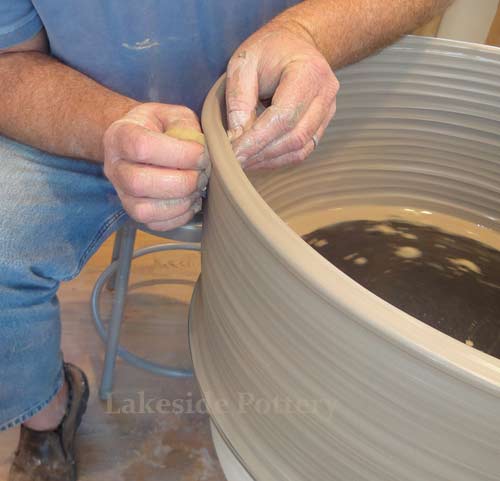
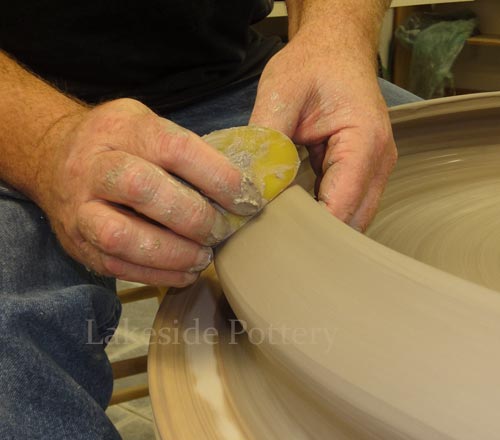
Very soft, pliable animal skin—when wet works well to smooth wet clay surfaces
|
| Candling |
The lower temperature stage of some firing cycles used to complete the drying of the ware
|
|
Casting slip
|
A cream-like mixture of clay and water used in the process of producing ceramic objects by means of pouring the slip into a porous mould. Water is drawn from the slip and into the mould, leaving a thin shell of soft but non-liquid clay around the inner surface of the form. When the slip achieves the proper thickness, the excess liquid is poured out and the remaining slip is left to dry completely. It is then removed from the mould, cleaned up, glazed and fired. This quick and simple process is used for mass produced ceramics leaving only the glazing as an opportunity for uniqueness. The term slip casting is also used to describe the process. See also glaze, clay.
|
|
Ceramic change
|
A transition that takes place in clay when it is heated to approximately 1100 F or higher. At that temperature, chemically attached water molecules are separated from the clay particles. These clay particles are fused together and the ceramic object is permanently changed. Prior to the transformation, when clay objects are re-introduced to water the clay particles will slake (fall apart) and re-dissolve into the water. They can then be re-constituted into workable clay and used again. Low fired pottery is heated to only slightly beyond this point and will tend to be less durable than high-fired pieces. See also firing.
|
|
Ceramics
|
From the Greek word "keramos" meaning potter’s clay; it refers to clay products made permanent by the application of heat (see ceramic change). It also describes the subject of study of a person known as a ceramicist. In addition to artistic endeavors, ceramics have many applications in industry where it is used for engine parts, electronics, medical equipment, and many other areas. When discussing art, this term is often used interchangeably with pottery. Ceramic artists, today, are sometimes referred to as "potters". See also pottery
|
|
Cheesehard
|
The first stage in the drying process of a piece of pottery where it is still soft. See also greenware, leatherhard, blackhard, whitehard, bisque.
|
|
China clay
|
This term was originally used by the British for all ceramic imports from China and European imitations of it. Today, it implies a translucent white claybody covered with a glaze that is fired to a temperature lower than that to which the claybody is fired. See also bone china, porcelain.
|
| Chuck |
On the wheel, a temporary wet-clay form or reusable bisque-fired form upon which wares may be inverted for trimming |
|
Clay
|
A naturally occurring inorganic substance composed of very small "plate- like" particles. These particles, when mixed with water as a lubricant, can slide past each other with relative ease. Known as "plasticity" or "workability", this gives clay its unique characteristic. Clay with finer particles is said to be more plastic than coarser clays but there is also more shrinkage during the drying and firing process. The various classifications of clay are determined by size, color, chemical make-up and purity. See also claybody, porcelain, china. Choosing the Right Clay For Your Application
|
|
Claybody
|
As used by the ceramicist, a claybody, is a combination of various types of clay, minerals, and other materials. One material commonly added to the claybody is grog, which eases handling and increases durability. The recipe or formula is determined by the intended use of the final product to be produced. This is one of the reasons a combination of clays is used to create a claybody suitable to the ceramicists needs.
Preparation of the claybody will arrange the clay particles alongside each other, making the clay more workable and durable. There are numerous types of claybodies used in ceramics today. The most popular of these include earthenware, stoneware, bone china, and porcelain. When purchasing a piece of ceramics, it is important to choose pieces made with a claybody appropriate for the piece’s intended use. See also wedging, clay, grog.
|
|
Coiling
|
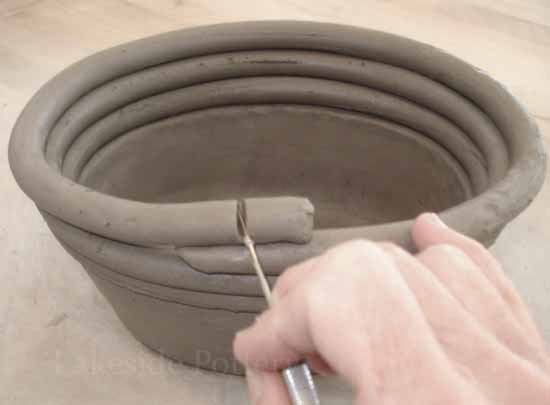
A hand building technique where snake-like pieces of clay are placed in a spiral formation, thereby building a cylindrical shape. The coils are then smoothed out so that the piece takes on a continuous contour. Only rarely are the coils left showing. Because coiling is a slow process and coiled pieces have an increased chance of weak points at any of the joins between the coils, coiled pieces generally do not lend themselves well to functional pieces. See also hand building.
See How to Construct Coil Pot tutorial / lesson
|
|
Cones
|
Small, elongated, three sided pyramids made of materials designed to melt at a specific temperature. Designed to melt at the same temperature as the glazes used. Cones indicate the progress of the melting. Cones are placed just inside the kiln during a firing so they can be seen through a peephole. The cones are one-time use only, and are available for a wide range of temperatures. They are numbered according to the temperature at which they melt. When discussing the temperature to which a piece/glaze is fired, reference is usually made to the cone used. The low fire range usually includes cones 06 through 01, intermediate fire includes cones 1 through 6, and high-fire includes cones 7 and up. See also firing, kiln. See Firing Tips and Tutorials
|
|
Contraction
|
A decrease in size due to a temperature change. It should not be confused with shrinkage, which is a non-reversible occurrence. Contraction is reversible with a reverse in the temperature change. As a piece of ceramics heats and cools, it expands and contracts. The rate of expansion and contraction of a glaze must be compatible with that of the claybody, otherwise flaking off or separation of the glaze may occur. In pottery, this should be a concern when considering glaze fit and ovenware. See also glaze fit, ovenware, shrinkage.
|
|
Crazing
|
Also referred to as "crackle" and "spiderwebbing", it is considered a defect in the glaze brought about by a difference in the amount of shrinking in the clay and the glaze. Usually undesirable, it is sometime used as a decorative element, but should be avoided for pieces intended for dinnerware and kitchenware. See also glaze.
All About Crazing and How to Avoid it
|
| Crackle glaze |
A glaze intentionally containing minute cracks in the surface. |
| Crawling |
A parting and contraction of the glaze on the surface of ceramic ware during drying or firing, resulting in unglazed areas bordered by coalesced glaze. Oftentimes caused by uneven glazing or three or more glaze coats.
All About Crawling and How to Avoid it
|
|
Decorative
|
A general term describing a ceramic piece that has no purpose other than art or decoration. Typical examples include sculptures, and wall hangings. Some seemingly functional pieces are only decorative pieces are actually decorative only because of how they are produced. See also functional.
|
| Dipping |
Glazing pottery by immersion in a glaze suspension.
|
|
Dunting
|
The cracking of pottery caused by stress during the firing and cooling process. During the firing, clay goes through what is called a "silica inversion" at slightly over 400 F and again at slightly over 1000 F. This transformation puts a lot of stress of the clay. Another cause may be the different contraction of the clay and the glaze. All pottery goes through this stress but most are strong enough to withstand it. Dunting is not always evident immediately upon removal from the kiln. It sometimes occurs as much as a month or more later but it should not be confused with cracks caused by "thermal shock". See firing.
|
|
Earthenware
|
A type of claybody usually associated with low-fired ceramics. Earthenware tends to be more porous than higher fired clays. The relatively low physical hardness of both the clay and the glaze tend to make earthenware less durable then higher fired claybodies and less appropriate a choice for functional pieces. See also stoneware, porcelain.
|
| Enamel |
Coloured, glass-like decoration applied to ceramic wares. Also called on-glaze decoration. Often made by mixing metal oxides with a flux. Enamels are usually fired to temperatures in the range of about 700 to 800 degrees Celsius.
|
|
Firing
|
The process of exposing ceramic pieces to high heat in order to convert them into durable finished pieces. During firing, the clay and/or glaze goes through a transformation whereby it is fused together into a solid piece. Unfired clay will dissolve in water, but the clay becomes impervious to water after firing. Although some fired pieces may still absorb water, this will have not an adverse effect on them.
An experienced potter can achieve a wide variety of results by carefully controlling such firing factors as the rate at which pieces are heated and cooled, the presence of other materials in the kiln, and the amount of air (oxygen) that is present in the kiln. Often, pieces are fired several times at various temperatures levels in order to achieve the potter’s desired results. Higher fired clays such as stoneware and porcelain tend to be less absorbent and more durable. See also kiln, oxidation, reduction, salt glaze, raku.
See Firing Tips and Tutorials
|
|
Flameware
|
Ware created with a claybody capable of withstanding extreme thermal shock produced by direct contact with an open flame or being subjected to a pre-heated oven. There are a number of factors that could classify a claybody as flameware, but the key factor is the ability of a piece to remain intact while different areas are experiencing a difference in temperature of several hundred degrees. When purchasing a piece for the purpose of such use, check the label or get some other form of confirmation. Flameware is sometimes referred to as "cookware", but it should not be confused with "ovenware" which cannot withstand a similar direct contact with a heat source. See also ovenware.
|
|
Food safety
|
Some glaze formulations may contain lead and other heavy metals, which may leach into liquids and foods placed in contact with the glaze. Today’s potters are keenly aware of this issue and are careful to use appropriate glazes and production techniques to eliminate these concerns. When shopping for pottery to be used for food, it is best to always ask and to shop at reputable stores that only carry pieces created by experienced potters. See also glaze, lead. Are Matt Glazes Food Safe - see more information
|
|
Form follows function
|
A philosophy of design that is used to determine the design characteristics of a piece produced for a particular purpose. The design or form of the piece is defined by the intended use in balance with aesthetic considerations, instead of being defined purely by aesthetics. If the function is less than acceptable, then that form must be corrected when used for subsequent pieces, even when the corrections remove aesthetically pleasing aspects of a piece. For example, a teapot may have a beautifully spiraled spout that is dribbles. Under this principle, the design of the teapot must be modified so that it functions correctly. See also functional, decorative.
|
|
Frit
|
Glaze materials that have been combined by melting and are reground to powder to be used in subsequent glaze formulations. There are several reasons why this process may be necessary. Some glaze materials are highly soluble in water. Soluble minerals cause problems for the potter when present in glaze recipes. The fritting process renders them insoluble. Another important reason is to "trap" hazardous materials, such as lead, which would otherwise be absorbed by the potter when working with finely ground glaze materials. See also glaze, grog.
|
|
Functional
|
A general term that refers to any ceramics piece that is not purely decorative and has some intended use. Typical examples include teapots, bowls, mugs, and vases. Some seemingly functional pieces may actually be decorative only because of how they are made, or because of the type of claybody or glazes used. For example, the artist may create decorative teapots that are porous, or may glaze bowls with glazes that are not food safe or that cannot take fluids well. When shopping for pieces for a specific purpose, make sure to confirm that they can, indeed, be used for that purpose. See also decorative, form follows function.
|
|
Glaze
|
A mixture of various materials and colorants, which are ground into a fine powder, mixed with water, and applied to ceramic pieces. This mixture, when exposed to high temperature during firing will melt and vitrify, thereby forming a glass-like surface that is fused onto the ceramic piece.
Glazes can be applied to dried unfired ceramics (greenware), or to ceramics that have been already been fired. Some complex pieces involve various cycles of glazing and firing to produce the artist’s intended effect. Glazes are usually referred to by the temperature, or cone, at which they melt. For example, a cone 10 glaze, which is a high-fire glaze.
High-fire glazes tend to be more durable, but have less color, whereas low-fire glazes are more colorful but are less durable, and intermediate glazes provide a good compromise. When purchasing ceramic pieces, it is important to consider the type of glaze in terms of food safety, durability, and fit with the underlying claybody. See also claybody, glaze fit, high-temp glaze, intermediate glaze, low-temp glaze.
See Lakeside Pottery Glaze Recipes
|
|
Glaze fit
|
The compatibility between the glaze and the clay used in the production of pottery. The match does not have to be exact but it must fall within an acceptable range. If not, various problems may occur with the piece, such as cracks in the glaze, shivering and shelling (glaze flakes off the clay) or dunting (various types of cracks in the claybody). The best way to avoid these problems when shopping for pottery is to deal with a reputable store or artist that will stand behind their pieces with a warranty and a good return policy. See also contraction.
|
|
Greenware
|
A stage in the production of pottery where a vessel and been from and is going through the drying process necessary before it can be safely fired. There several sub-stages in greenware. They are: Cheesehard, Leatherhard, Black-hard, White-hard. Several decorative techniques are possible during these different stages of the drying process. See also leatherhard, blackhard, whitehard, bisque.
|
|
Grog
|
A sand-like substance that is added to a claybody to add workability and strength to the clay. Grog is actually high-fired clay that has been ground down to a granular state. Because it has already gone through the firing process, it lessens the shrinkage of the claybody. In clays that require great resistance to thermal shock, such as Raku and flameware, large amounts of grog are usually present. See also shrinkage, claybody, raku, flameware.
|
|
Hand building
|
Any one of various techniques for creating ceramic objects that do not involve the use of a potters wheel. These methods include coiling, slab building, and pinch pots. Hand built pieces are usually decorative instead of functional, primarily because the seams make them less durable and the unevenness of the surface makes them more difficult to clean. See also coiling, slab, pinching.
See Hand Building Project Ideas
|
| Hydrometer |
Laboratory device for measuring specific gravity in slips and glazes. Does not give absolute measurement, and should be used only for comparing and reproducing results. Must be an appropriate glaze hydrometer for measuring suspensions heavier than water. Does not work well in thick glazes. |
|
High-temp glaze
|
Glazes that have a maturing temperature at or above 2200 F (cones 7 and up). High-temperature glazes are known as stoneware and porcelain glazes. They tend to be more durable but less vibrant in color. Functional pieces such as casseroles and dinnerware are usually better if they are high-fired ware. Sometimes referred to by the "cone" to which they are fired, as in a Cone 10 glaze. See also glaze, cones.
|
|
Intermediate glaze
|
Glazes that have a maturing temperature between 1900 F and 2200 F (cones 1-6). This is a wide range and not all intermediate glazes are interchangeable. A piece that has a good fit between the claybody and glaze within this range may be as appropriate and long lasting as high- fire wares, and are often more colorful. See also glaze, cones.
|
| Iron oxide |
A common oxide in glazes and some clays that generally gives a reddish colour.
|
| Kaolin |
Also known as china clay, white or off-white firing kaolinitic. Used to make porcelain.
|
| Kidney |
A kidney-shaped tool made of flexible steel for finishing thrown pots, or made of stiff rubber for pressing and smoothing clay in a mould.
|
|
Kiln
|
The oven in which ceramic pieces are fired to convert them from unstable greenware into durable finished pieces. This term is derived from the Latin "culina", which refers to a structure built for the purpose of retaining heat that is introduced into the main chamber. There are a wide variety of kiln types from the earliest known open pit of pre- historic times to the sophisticated, efficient structures used by today’s ceramicists. The many different types of kilns include: anagama, updraft, downdraft , gas burning, electric, wood burning, open Pit, centenary arch, raku, climbing, and salt. See also firing, oxidation, reduction.
Tips and leassons on Firing Electric Kiln
|
| Kiln furniture |
Refractory shelves and posts upon which ceramic ware is placed while being fired in the kiln. Stacks or Chimneys come in varying heights from 3/4" to 8 to 10".
|
| Kilnwash |
A coating of refractory material applied to saggars, kiln furniture, etc, to prevent sticking during firing.
|
Kinsugi
Kinsukuroi
|
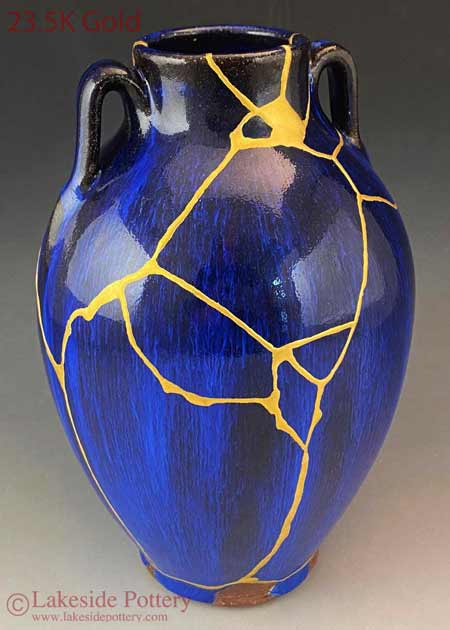
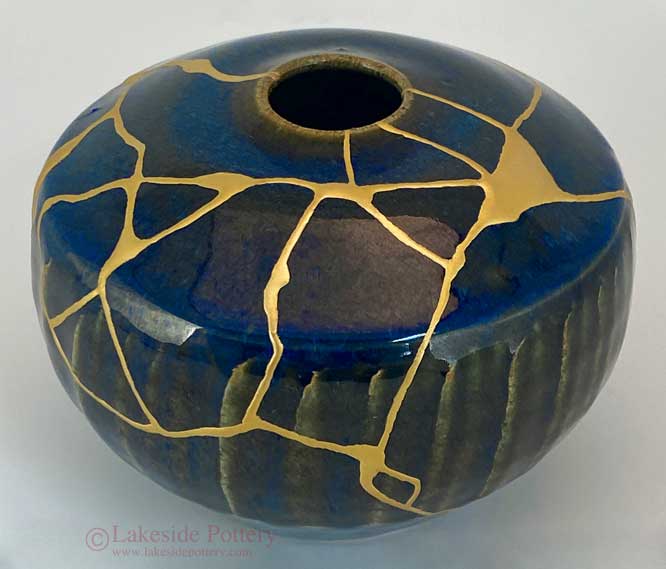
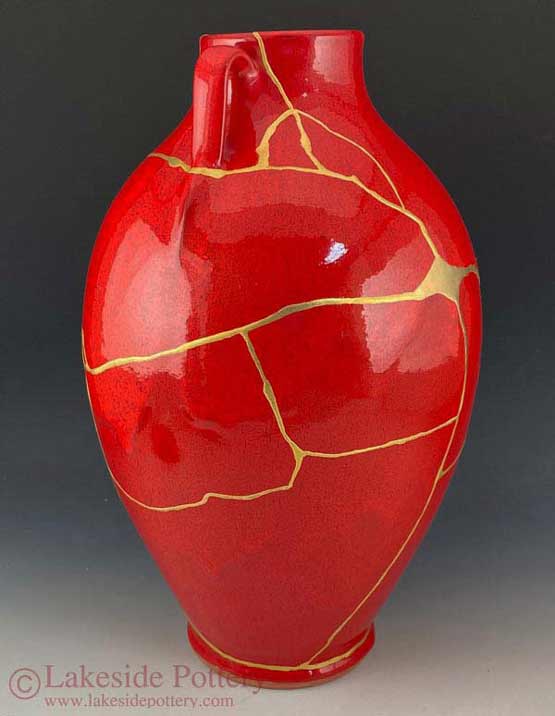
The translation from Japanese of Kintsugi or Kintsukuroi means golden joinery or repair with gold where the gold powder is applied on lacquer. Some refer to it as Kintsugi art with a metaphor of Kintsugi life, re-birth, or Wabi-sabi philosophy. This technique transforms broken ceramic or pottery into beautiful art to it's its new life enhancing the break lines with gold giving the mended broken pottery a pleasing and unique presentation.
See Examples
|
|
Lead
|
Lead has traditionally been a key ingredient in many glaze formulations. Since these can leach into liquids and foods, you should take this into account when shopping for ceramic pieces to be used for food. The danger is in the cumulative effects that occurs with the repeated use of everyday functional pieces. Fortunately, most functional ware is fired to higher temperatures where lead, commonly used as a flux (melting agent) in lower fired glazes, will not be present or would tend to have been burned off during the glaze firing. If you have any doubt or concern over the possibility of lead poison, you should always inquire before making a pottery purchase. See also food safety, glaze.
More information about Lead in Clay
|
|
Leatherhard
|
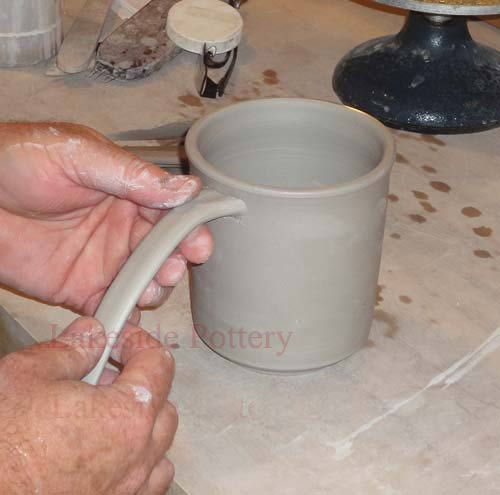
A stage in the drying process when a clay object can be carefully handled without danger of the shape being deformed, but the clay is still pliable enough so alterations can be made if desired. Many ceramic artists take great advantage of this relatively short period of time to add personal and unique characteristics to their creations. It is also the stage when attachments, such as handles, are added to wheel-thrown pieces. See also greenware, blackhard, cheesehard, whitehard, bisque.
|
|
Low-temp glaze
|
Glaze which matures at 1900 F and lower (cones 06 – 01). Considered a "soft" glaze, it is less durable than the underlying claybody. Due to the relatively low melting point, the presence of lead is almost definite. However, if the lead is used in a "frit", the danger of lead poisoning is greatly reduced if not altogether eliminated. See also glaze, cones, frit.
|
| Low mid range |
Firing range usually including cone 01 to cone 3, underused in studio ceramics, useful for functional earthenware, refractory sculpture bodies, and outdoor terra cotta work.
|
|
Lusters
|
Metallic materials applied on glazed surfaces. Lusters are pure metals dissolved by hydrochloric acid, which are then suspended in an oil base that can be applied with a brush. Precious metals are often used but whatever the metal, lusters are generally only used as highlights such as pinstripes or small applications. The firing is at an extremely low temperature (1200 F). The oil resin is burned out leaving, on the glaze surface, a very thin deposit of metal that can easily rubbed of with extended use of the piece. See also glaze.
|
|
Maiolica
|
An opaque, lead-glazed, earthenware originated in the Mediterranean area. Should not be confused with Majolica. See also glaze, majolica.
|
|
Majolica
|
Originating in late 19th century England, Majolica has a pale yellow claybody with shiny colorful glazes. The surface was highly modeled providing many "pockets" where the glazes collected to create variations in color saturation. Majolica today still carries the connotation of brightly colored glazes but the surfaces of the wares tends to be smooth allowing for eye catching decorative possibilities. Should not be confused with Maiolica. See also glaze, maiolica.
|
| Maturing temperature |
The temperature at which a glaze exhibits it best qualities.
|
|
Ovenware
|
Pottery made specifically for use in oven cooking. The claybody used must be capable of withstanding thermal shock. This should not be confused with flameware, which has the ability to withstand direct contact with a heat source such as an open flame. There are several factors to consider when selecting a piece for oven use. Beside the ability to withstand temperature changes, the piece should be designed for ease of handling, especially when hot, ease of cleaning, and have an appropriate shape. See also form follows function, flameware.
|
| Orton cones |
See pyrometric cone.
|
|
Oxidation
|
In pottery this refers to a process that takes place during the firing stage of production. Oxygen in the air is allowed to enter the kiln to combine with elements in the clay and glaze. This is particularly important so that carbon and sulfur naturally occurring in clay can be "burned off". This takes place between temperatures of 1300 F and 2100 F. While all pottery firings go through a stage of oxidation, when it is allowed to continue throughout the entire process, it is called an "oxidation firing". An opposite effect is known as a "reduction firing". See also firing, reduction.
|
| Paper clay |
Adding reconstituted paper pulp to ordinary plastic clay in proportions up to 50% of the total mass. The added paper gives an unfired material great strength, giving an advantage to hand builders and sculptors.
|
|
Pinching
|
A technique of building pots entirely by molding the clay with the hands without coiling, using slabs, or throwing. Called pinching because it usually starts by a potter inserting a finger into a ball of clay and pinching the walls to thin and shape the pot. See also hand building, throwing.
See a Pinch Pot Lesson
|
| Pinholes |
Faults in the surface of a ceramic body or glaze which resemble pin pricks.
All About Pinholes and How to Avoid it
|
| Plasticity |
The quality of clay that allows it to be manipulated and still maintain its shape without cracking.
|
|
Porcelain
|
Introduced in Europe by Marco Polo after his excursions to China, true porcelain is a very high-fired (2300+ F) white ware, which, when thin enough, has a translucent quality. At these high temperatures, the body and the glaze mature together, creating a thick bonding layer. This gives porcelain great strength and durability. Due to many difficulties of working with porcelain, several imitations have been developed. These are referred to as china, bone china, and sometimes erroneously as porcelain. Although they may not have the same high qualities as true porcelain, they may be perfectly adequate for use and will most likely be less expensive. See also china, bone china, earthenware, stoneware.
|
|
Porosity
|
The ability to absorb water by capillary action. Over a period of time, this tends to weaken a claybody, and therefore should be a consideration when shopping for pottery. In high-fired ware, with a desired porosity of 1% to 2%, the concern is less important. However, low-fired pieces must be covered with a non-crazed glaze to minimize the effects of water absorption. This is not to say that low-fired ware should necessarily be avoided, but it may be less appropriate for some intended uses. See also crazing.
|
|
Potter's wheel
|
A device used by a potter to rotate a lump of clay on top of a disk, which allows a skilled craftsperson to create a variety of cylindrical shapes for a wide array of functional objects. This activity is called throwing. Although the "knack" for creating a pot on a wheel can be acquired in a relatively short time, creating high-quality, aesthetically pleasing, well-proportioned pieces takes many years of experience and long hours of practice. See also throwing, hand building.
Throwing on the pottery wheel - step by step tutorial
|
|
Pottery
|
Although this term is usually used interchangeably with ceramics, it more precisely refers to ceramic objects that have a container shape, such as pots, planters, and tureens. It also can be used to refer to factories that produce pottery pieces. See also ceramics.
|
| Production pottery |
Sometimes known as standardware, refers to systematic, large-scale production of identical wheel thrown pottery vessels.
|
| Pug mill |
A machine for consolidating plastic clay or body into a firm column. It consists of a barrel which tapers at one end to a die, through which the clay or body is forced by knives mounted on a shaft which rotates centrally to the barrel. A vacuum system may be installed to de-air the clay or clay body.
|
| Pyrometer |
A temperature indicator linked to a kiln via a thermocoupler.
|
| Quartz inversion |
This term refers to an abrupt change in volume that occurs in quartz crystals when they are heated from the room temperature stable alpha phase to the beta crystal phase that exists above a theoretical temperature of 573C. Quartz inversion can be beneficial because it can put the glaze under compression and thus prevent crazing.
|
|
Raku
|
Raku is a classification of ceramics that falls into the low-fire range. The term "raku" describes the piece as well as the firing process used to create it. Originally developed in Japan as a technique for quickly producing small functional vessels, in Western Civilization, because the process has been somewhat altered, raku ware is primarily created as decorative pottery. The most interesting aspect of the technique is that a piece is taken directly from the kiln into a raku pit while it is still very hot. The raku pit is lined with combustible materials, which immediately ignite. The pit is covered, and the resulting fire and smoke add a wide variety of finishes to the piece. The process is quick, exciting, and predictable only within a certain range of possibilities. The uniqueness or "one-of-a-kind" aspect of a raku piece is impossible to reproduce. This, along with its shortcomings for functional use, is the reason raku is popular primarily for decorative purposes. See also firing.
|
| Rib tool |
A wide, flat handheld tool used to shape, smooth, and/or scrape clay surfaces; usually wood, rubber, plastic, or metal, either rigid or flexible, with straight, curved, or profiled edge.
|
|
Reduction
|
Refers to a glaze firing process or a glaze mixture that is best enhanced when going through this type of firing. What is actually being reduced is the quantity of oxygen that is chemically bonded to any metal oxides in the clay or glaze mixture. To bring about the removal of oxygen molecules, when the kiln temperature reaches the melting point of the glazes used the kiln atmosphere is "flooded" with combustible material, such as gas or wood, thus causing the fire to pull oxygen from the pieces being fired. The duration of the stage varies, but it can be as long as an hour or more. The removal of iron oxide in clay causes a "fluxing" (melting) action thus creating a stronger bond between clay and glaze. In the glaze mixture, reduction brings about a wide array of colors depending on the combination of materials used in the glaze. In general, reduction fired glazes tend to have what is considered warmer tones than those of oxidation glazes. Both have the potential for beautifully produced pieces. See also oxidation, firing, kiln, glaze.
|
| Sagger |
A lidded or covered ceramic box used to protect wares from direct flame, smoke, fuel-ash or cinders during firing. |
|
Salt glaze
|
A glaze that is derived from the introduction of salt (usually common table salt) into the kiln atmosphere. The salt quickly decomposes and vaporized and combines with alumina and silica from the clay in the pieces, creating a glossy surface. This salt glaze actually adheres to everything within the kiln chamber so the wares must be placed on stilts or have the bottoms coated with materials resistant to the salt vapors. This renders the kiln a salt-glaze-only kiln. The one place this vaporizing glazing action does not occur is inside pots, unless they are shallow forms with a wide opening. To overcome this, many potters coat the insides with glaze prior to the firing. Decorative slips are often used on the outsides of the pieces. Pieces created with a salt glaze are sometimes referred to as saltware, and the process, because of the sodium in the salt, is also referred to as sodium firing or sodium glazing.
This is a single-firing production process that produces a very durable glaze with the potential of very beautiful and interesting glaze patterns. Unfortunately, the process creates several very poisonous gases and is increasingly outlawed in many areas. See also glaze.
|
| Sgraffito |
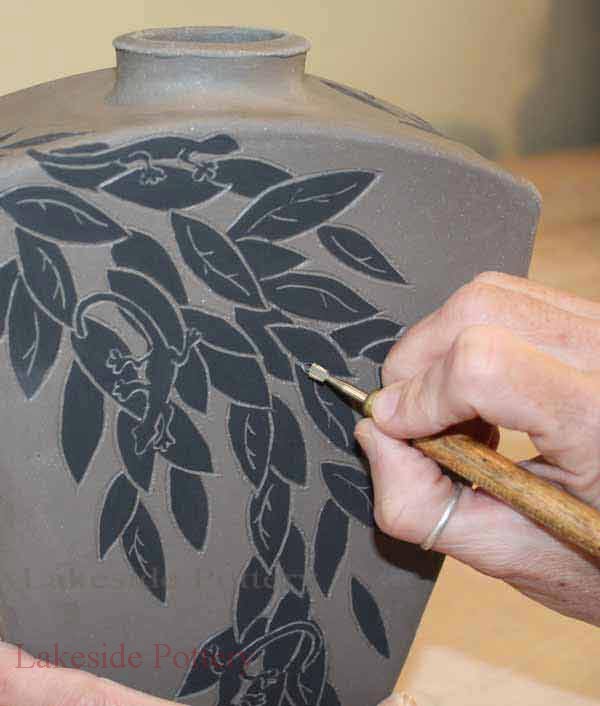
This is a decorating technique where a slip is applied to a leather-hard piece of clay and left to dry. Once the slip is dry a host of different tools are used to carve into the clay to remove the slip and leave an embedded decoration behind.
How is Sgraffito Made and Examples
|
|
Shrinkage
|
An irreversible reduction in the size/volume of a ceramic piece or glaze which is caused during the drying and firing process. This differs from expansion and contraction, which occurs naturally as a piece heats and cools. All pieces usually undergo a small amount of shrinkage. It takes a lot of experience and skill to select and work with the right types of clays and glazes so that shrinkage does not deform or otherwise damage a finished piece. See also contraction.
|
| Sieve |
A container with fine-mesh wire screen in the bottom, available in different mesh sizes, used for straining slips and glazes in order to achieve complete mixing of raw materials and removal of large particles or contaminants. |
|
Slab
|
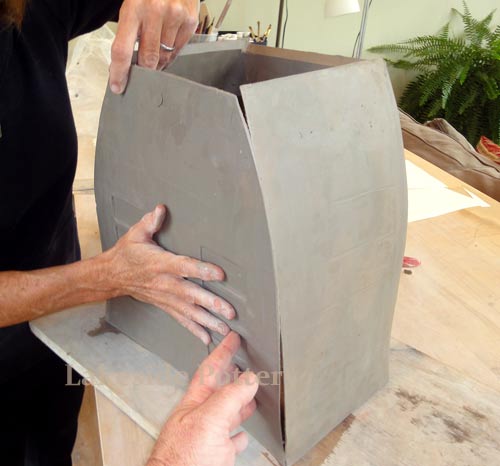
Also slab built. Any one of various techniques for creating ceramic objects that do not involve the use of a potters wheel. In this technique, the clay is pressed into thin slabs that are then cut, assembled, and shaped into the desired form. See also hand building, coiling, pinching.
Slab Project Lesson
|
| Slab roller |
A mechanized or manually operated device for rolling out large uniform slabs of clay. |
|
Slip
|
A mixture of clay and water usually with coloring agents in the form of metallic oxides. Mostly seen as brushwork, slips are best applied during the greenware stage of drying. There is also a process of creating pottery from slip called casting slip, or slip casting. See also greenware, casting slip.
|
| Slip casting |
Technique for forming the body of a piece by using slip in a mould
|
| Slump mold |
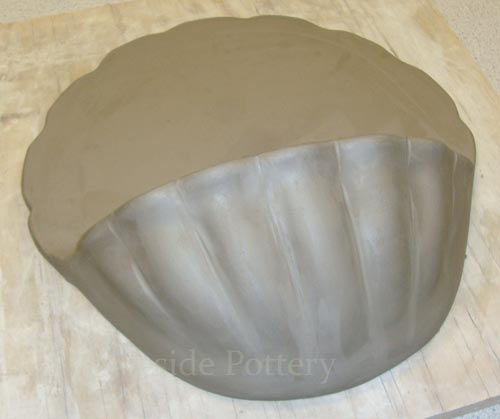
A typically shallow frame or mold into which a slab of clay is allowed to fall or settle in order to form a vessel. These can be frames with no bottom.
Slump Mold Project Example and How it is Made
|
| Slurry |
An aqueous suspension of clay and water
|
|
Stain
|
A compound added to glazes to add coloring. Sometimes applied directly onto a clay body without mixing with a vitrifying glaze. See also glaze, vitrification.
|
| Soaking |
A period during a firing cycle when a constant temperature is maintained. |
| Stilt |
Supports used to prevent glazes from fusing the pot with the kiln when fired. |
|
Stoneware
|
A strong, hard, vitrified ware, usually high-fired above 2,200 F, in which the claybody and glaze mature at the same temperature, forming an integrated clay-glaze layer. This high-firing process brings the clay to a point of maximum solidification without danger of distortion, creating pieces very suitable for kitchenware and other functional pieces. See also earthenware, porcelain, claybody.
|
|
Temperature
|
A very important consideration in the production of ceramics. The temperature at which the claybody and glaze of a piece need to be fired is determined by a variety of factors and in turn determines attributes of the finished piece such as durability, porosity, density, and color. In general, low-fired pieces tend to be less durable but have more colorful glazes, while high-fired pieces are more durable, less colorful, and work better as functional pieces. See also firing, kiln, cone.
|
| Tenmoku |
A stoneware glaze deeply coloured by iron oxide. It produces often lustrous results that vary in colour from yellow, green, rust red, brown and black.
|
| Tensile strength |
The resistance of a material to being torn apart by tension or pulling. |
| Thermal shock |
Thermal shock is the way in which some materials are prone to damage by stresses set up due to differences in temperature in different parts of the article.
|
| Thermocouple |
A device for the measurement of temperature based on the voltage generated when two dissimilar conductors are heated in contact e.g. copper/constantan, chrome/alumel, platinum/rhodium, etc. |
|
Throwing or wheel-thrown
|
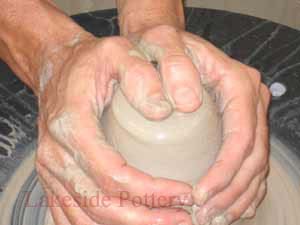
A process of producing pottery by use of a rapidly rotating disk referred to as a potter’s wheel. The procedure involves placing a lump of clay in the exact center of the wheel head, creating an opening in the exact center of the clay. The size of the opening is gradually increased and the sides are pulled up until a cylinder is formed. A sufficient amount of clay is left for the bottom of the piece. The sides and mouth of the piece are then shaped, and the piece is removed from the wheel. Once it dries to a leatherhard stage, the potter can then go about trimming away excess clay, adding handles, spouts or attachments, and carving, cutting, or re-shaping the piece. An experienced potter can make this process look easy, but it takes many years of dedication and long hours of practice to become efficient at throwing and creating balanced, beautiful pieces. See also hand building.
Throwing on the pottery wheel - step by step tutorial
|
| Underglaze |
Decoration applied to biscuit pottery and covered with a glaze. |
|
Vitrification
|
The process, induced by exposure to high heat, by which a material such as a clay or a glaze, melts and fuses together, thereby becoming solid and glass-like. This is what happens to ceramics and glazes during the firing process, and what converts a form made of soluble materials into an insoluble and permanent piece of ceramics. See also firing, glaze.
|
|
Ware
|
A generic catch-all term referring to ceramic pieces. It is usually combined with adjectives to form compound words such as kitchenware, dinnerware, earthenware, stoneware, and ovenware. See also flameware, ovenware.
|
| Water absorption |
The mass of water absorbed by a porous ceramic material, under specified conditions, expressed as a percentage of the mass of the dry material. It is a common quality control test used for both ceramic raw materials and ceramic bodies. |
| Wax resist |
Used as a masking medium for application to areas on which no glaze is required. |
|
Wedging
|
A manual process of preparing clay for use by a potter. Similar to kneading dough, wedging accomplishes three things: a) it removes air pockets present within the clay mass, b) it helps to align the individual clay particles making the process of throwing slightly easier and the clay stronger, and c) it is a final mixing process that tends to even out water concentrations in the clay as well as homogenize the various ingredients in the clay mixture. See also clay, claybody.
Making a wedging table - step by step instructions
|
|
Whitehard
|
A stage in the drying of a piece of pottery where it is fully dry and has very little moisture. At this point it is ready to be fired in the kiln. It is important that a piece be as dry as possible before firing because moisture trapped inside the clay can explode as it heats in the kiln. See greenware, leatherhard, blackhard, whitehard, bisque.
|